Saturday, March 16, 2019

Space-Based Solar Power Next Up on China’s Cosmic To-Do List

The community is, once again, taking a giant leap forward. Solar energy researchers have been utilizing water, land, and air to fuel renewable energy processes for years, and now, the race is on to build solar energy satellites in space. China, in particular, is at the forefront of bringing the idea of creating solar energy satellites into full fruition, at least in this century. The nation’s ambitious plan calls for the launch of a series of small solar power satellite stations into the Earth’s stratosphere between 2021 and 2025. By 2030, the solar power stations will be upgraded to megawatt-level facilities and gigawatt-level capacity by 2050. 

Space-based solar energy is a brilliant, but a highly speculated idea. The brilliance is that sunlight exists in space 24-hours a day, making it the optimal environment to harness solar energy from the sun. The problem, however, is getting the solar energy collected back to Earth in a useable form. China is proposing that the solar energy be converted into electricity right in space prior to being beamed back via laser or microwave frequencies into a receiving system. 

Revisiting a Decades Old Idea 

Believe it or not, solar energy in space is not a new idea. In fact, space-based solar power (SBSP) was first introduced by a science fiction writer by the name of Isaac Asimov. In 1941, he published a science fiction story titled, ‘Reason.’ the novel depicts a space station that is able to collect and solar energy and transmit it to other plants in the solar system through the use of microwave beams. The concept of space-based solar power as we know it today, however, was not introduced until 1968. Then, in 1973 a U.S. patent allowed researchers at Arthur D. Little, Inc in Boston to test how to transmit power over long distances, such as from a satellite solar-power system (SSPS) in space, back to Earth’s surface. Peter Glaser, the vice president of Arthur D. Little, Inc at the time, then expanded his research to include NASA and four additional companies to participate in a broader, investigative study into the transmission of energy through space-based solar power. 

The United States Department of Energy teamed up with Arthur D. Little, Inc and NASA to further investigate the concept of space-based solar power from 1978 to 1986. With approval from Congress and a budget of $50 million, the DoE and NASA named the study the Satellite Power System and Concept Development and Evaluation Program. The primary purpose was to test the engineering capabilities and general feasibility of space-based solar energy.  

After the program was discontinued, NASA revamped its interest in 1997 in order to assess what had changed from the initial DoE space-based solar energy study. Concerns over the costs of a space solar energy program were debated by NASA officials, with some experts stating that certain investments would drive down space-based solar costs, while others like Dr. Pete Worden claimed that any solutions proposed at the time being unfeasible, highly expensive, and decades away. 

The Challenges of Space-Based Solar Power 

Over two decades since Dr. Worden first voiced his speculations, China is taking the lead in the solar community and getting serious of space-based solar energy. The task at hand, however, will present numerous, seemingly insurmountable challenges. Primarily, the weight of the solar stations themselves. It is predicted that each power station could weigh as much as 1,000 tons. Due to the predicted weight of the stations, initially getting them into orbit will be difficult. One solution has been to use 3D printing, where possible, to construct the solar-based power stations. Additionally, the effects of the microwave radiation that will be beamed back to Earth will need to be studied.  

Even though obtaining and utilizing solar energy from space may present some of the greatest challenges that solar energy researchers have faced, keep in mind that it has been less than 80 years since Asimov first proposed the idea of space-based solar power. Throughout every decade since, there has been notably and historical progression in our technological advancements. It is not in the slightest bit outlandish to believe that someday very soon, solar satellites will be able to provide clean and sustainable energy for our entire planet. 

Resources:

https://www.engadget.com/2019/02/18/china-solar-farm-power-station-space-2025/ 

https://www.nbcnews.com/mach/science/solar-farms-space-could-be-renewable-energy-s-next-frontier-ncna967451 

Wednesday, March 6, 2019

Solar Panels – Money Crop for Farmers

, 50, farms 6,500 acres of land with his cousin and brother. They grow crops such as soybeans and corn, and have the goal of adding more on 15 acres of land. They want to sell this . DeBaillie pointed out that even on a foggy day, his panels are still able to generate electricity.

According to DeBaillie, earnings from the additional solar panels would be approximately three times what a typical harvest yields. Many are making the decision in Illinois to host acres filled with solar panels. It’s a move state law is behind, because the goal is to have a quarter of Illinois’ power provided by renewable sources (such as solar power) by the year 2025.

Concerns Regarding this Shift

The shift to using solar panels is debatable, for reasons beyond how it might impact the pastoral landscape. There are concerns over an otherwise booming population, too. But if you ask farmers, they will talk to you about indeterminate economics and the need for the income. Costs in 2018 for some of the most prominent crops in Illinois were less than original forecasts. Soybean costs dropped substantially as a result of the trade war between China and the Trump administration. Of course, climate change is another factor leading farmers to take advantage of acreage for solar panels.

In accordance with the federal government’s Fourth National Climate Assessment, humidity increasing and higher temperatures are leading to problems such as more pests on farms. Farmers believe that solar panels could benefit the planet as well as retirement accounts, and help with climate change. They could, essentially, be the change we need to help farmers.

There are different solar panel projects available. One is quite small in size and is designed for small businesses or residential properties. The solar panels are placed on rooftops. Then there are the solar projects that are medium in size – community solar. These require placing solar panels over approximately 15 acres of land. A project of this scale can power roughly 2,000 homes. The biggest size is able to cover up to thousands of acres. It’s almost like a personal power plant.

Due to unanticipated popularity, Illinois is actually going to host a lottery to decide who will be able to obtain contracts to sell solar to big power companies. The expectation is that roughly 1,000 applications are going to be received.

In accordance with Illinois Power Agency officials, as more solar projects go online, production is going to increase from 80 to 100 megawatts.

In order to meet the state’s 2025 goal, Illinois Solar Energy Association believes that new installations are going to need to be built to produce an extra 10,000 megawatts of energy capacity.

As mentioned, an obvious concern is that too much space will be taken up by the solar panels, impacting the landscape. So, people like (head of Midwest development for Summit Ridge Energy), have commented on the push for solar panels to be placed on less-productive acreage to avoid impacting farming operations. For every problem, there seems to be a solution.

A Clear Dedication

Randy DeBaillie’s great-grandfather came, during World War I, to Illinois from Belgium, and four generations of his family has worked on the land. He personally installed the sheds that act as the company’s headquarters. He has put a lot of time and effort into this land, and does so with solar panels, too. When they are covered in snow, he clears them off, so they can continue to properly function.

Newer Projects on the Horizon

The state of Illinois’ flagship university, the at Urbana-Champaign, built its first 20-acre solar just a few years ago in 2015 to lessen its dependency on fossil fuels. A new project, which will cover 55 acres, could be finished as early as 2020. There is an obvious urgency to move forward with regard to clean energy usage.

The University of Illinois at Urbana-Champaign has a focus on building solar panels on less-productive fields. Professors are looking into ways to grow high-value crops around the solar panels in an effort to keep land in production.

Solar panels are becoming a “money” crop for farmers, and there are many reasons for this. Keep reading solar news to learn how renewable energy is being used in the area you live. There are many great things to come, even though there are still hurdles to work through. Solar is on a roll!

 Sources:

https://www.roanoke.com/washingtonpost/business/next-money-crop-for-farmers-solar-panels/article_0c8e8e19-93b4-5860-beda-095868db2f87.html

https://www.washingtonpost.com/business/economy/the-next-money-crop-for-farmers-solar-panels/2019/02/22/2cf99e8c-3601-11e9-854a-7a14d7fec96a_story.html?noredirect=on&utm_term=.799bced95c0d


Egypt Has Competitive Position in the Global Solar Energy Industry

Egypt has been looked to as a hot spot for production over the last decade due to its abundance of land space, high winds, and sunlight. The overall climate in Egypt makes it a prime location for solar, wind, and renewable energy production and growth. In recent years, more solidified plans of action to bring solar energy to the country have been laid out. According to the latest data, Egypt is aiming to provide at least 20 percent of generated electricity in the area through solar or renewable energy by the year 2022. The breakdown for this goal will have wind energy comprising 12 percent of the renewable energy sources, with hydropower at just under 6 percent and solar power at 2.2 percent.  

What Experts are Saying 

Policy analyst for Bloomberg in Europe, Africa and the Middle East, Katherine Poseidon, told Daily News Egypt that Egypt undoubtedly has one of the, “strongest markets in the Middle East,” for solar and renewable energy production. At the annual Solar and Wind Show in Cairo in February of this year, Poseidon noted the introduction of a new, fixed tariff model in Egypt’s solar energy sector will allow more developers to become involved in the market, but also increase competition in the area among investors. Ultimately, the feed-in tariff model aims to bring down the cost for solar energy investors and those involved in the initial markets. 

In the annual report produced by Bloomberg to determine which global environments have the greatest opportunity for solar energy production, Egypt’s score went up considerably in 2019, making the coveted region even more competitive in the solar energy sector. The country is now on the fast track towards becoming a “regional energy hub” that will compete with other solar energy producers and markets in the region. The race to the top of the solar energy market in the Middle East will not be free of challenges, however. 

 Board member of the Middle East Solar Industry Association (MESIA), Gurmeet Kuar, noted that the biggest challenge when it comes to solar and renewable energy production in Egypt will be how to supply consumers with energy supplies at night when there is an absence of sun. Solar energy storage for this specific concern has been heavily investigated by solar energy researchers worldwide. Finding proper means of storing solar energy will need to be one of the top priorities for those in the solar energy sector in Egypt. Kuar stated that taking advantage of the omittance of traditional electricity subsidies in the Middle East, along with their focus on smaller projects, such as rooftop solar panels, will help the country remain competitive. She also told Daily News Egypt that her hope is that, in time, licenses and permits will be less of a hassle for solar energy developers to obtain in the region. Ultimately, a mix of both renewable and solar energy resources, as well as traditional fossil fuels, is the most realistic goal for now. 

Wind and Solar Energy in Egypt 

Wind energy will play a huge role in Egypt’s renewable energy future. The focus is primarily on wind energy due to the consistent and powerful winds in the area. Since 2001, countries like Germany, Denmark, Japan, and Spain have established solar wind farms in Egypt, resulting in a massive increase in renewable imports in the last decade, particularly by 2013 when a Spanish project was constructed in Jebel El Ziet.  

Egypt is considered to be a “sun belt” country, according to Egypt’s Solar Atlas. Its global position makes it an ideal location for both wind and solar energy production. Egypt’s first solar energy plant was built in 2011 in Kuraymat, with several more being built in the years that followed. Currently, there is talk of implementing solar and wind energy plants near both the West and East Nile areas. It is projected that as much as 52,300 MW of solar energy and 31,150 MW of wind energy could be generated from these regions. 

Resources 

https://dailynewsegypt.com/2019/03/02/egypt-on-right-track-toward-renewable-energy-yet-it-needs-to-exert-more-effort-experts-2/ 

https://www.export.gov/article?id=Egypt-Renewable-Energy 


Monday, February 25, 2019

Google Reinventing Floating Solar Panels in Taiwan

Google has recently purchased a large fishing pond in Taiwan that will be used for a new floating production site. In Tainan City, Google is the first international company to take advantage of the Taiwan Electricity Act, which was established in 2017. This act allows companies to buy and manage solar and renewable energy programs in Taiwan. This also marks the first water solar energy-based investment Google has made thus far in its history, as well as the first time Google has entered into the Asian solar energy market. 

How Google’s Floating Solar Panels are Different 

Traditional floating solar panels are known as “floatovoltaics,” a term coined using a combination of the words floating and photovoltaics. These types of solar energy productions sites are becoming more and more popular worldwide for several reasons. The number one perk is the ability to construct solar energy production sites where there is limited land space. Some areas may not have adequate land or rooftop space to build solar panels, but they may have bodies of water nearby. Floating solar panels solve the problem many urban areas face when it comes to implementing solar energy. In addition to conserving land space, floating solar energy panels provide shade for the bodies of water they float on. This prevents excess evaporation overall, helping to conserve water.  

Google is aiming for an improved design for its floating solar panels. The proposed 10-megawatt floating solar farm will be built using poles that will elevate the panels above the water. While the panels will still technically be floating on the water, there will be more space between the solar panels and the surface of the water. 

The Benefits of the Canopy Design 

Utilizing the space above bodies of water has plenty of advantages, but Google is hoping to improve conditions even more. In Tainan City, fishing is a primary economic and agricultural staple and multiple fish farms can be found near the coastline. In order to protect this the fish farms, Google has been experimenting with a new floating solar design that will make it so the panels are hoisted just above the surface. Google is referring to this design as a canopy system.  

It is also projected that the canopy solar panels may even increase fishing yields for fishermen in the area. Increased space between the panels and the surface of the water, in addition to increased shade, may provide the perfect environment for local fish to thrive. These findings, found through an experiment conducted by the Fisheries Research Institution and Taiwan Council of Agriculture, only emphasize the logistical benefits of floating solar panels. The project is scheduled to be completed sometime in 2020. 

More Solar Projects from Google 

Google is currently the largest corporation investing in solar energy utility and production. With over 30 solar, wind, and renewable energy projects currently underway worldwide since 2010, it is no surprise that Google is already working to reinvent solar energy as we know it. Mike Terrell, Google’s head of energy and market development, told CNBC that entering into the solar energy market makes “business sense.” Price reduction in the solar market has undoubtedly influenced their decisions over the past decades.  

The project in Taiwan is not the first creative or challenging renewable energy project that Google has become involved in. Google also works with the El Romero Solar PV Plant in Chile to cultivate and purchase solar power. The plant is located in Chile’s remote and extremely dry Atacama Desert, making it both ideal for solar power production, but a challenge in and of itself. 

The international solar production sites themselves are just a part of Google’s overall solar energy involvement. Google also constructs and manages data centers, with the newest being established in Tennessee and Alabama. To create the Tennessee facility, Google has teamed up with Tennessee Valley Authority, NextEra Energy, and Invenergy. This marks one of the largest partnerships Google has entered into yet in the solar energy industry. These and other ground-breaking moves indicate that Google is only just getting started when it comes to solar and renewable energies. 

Resource:

https://www.cnbc.com/2019/02/15/google-is-building-a-solar-power-project-above-fishing-ponds-in-taiwan.html 

http://www.hydrogenfuelnews.com/google-moves-forward-with-its-first-floating-solar-energy-project/8536959/ 

Friday, February 22, 2019

Granite City Bar & Restaurant Runs on Solar

Eddie’s Lounge in , IL is a bar and grill that has worked its way onto the map by becoming a regional leader in clean . Jim Dunn is the proud owner, and he recently installed enough to generate all the electricity for the building. You’re probably wondering what sort of number this equates to. Get ready to be impressed – Dunn has almost completely wiped out his $15,000 annual electric bill, thanks to the power of .

Here’s some quick background information: Dunn, 69, believes his move toward solar makes sense economically. He spent many years living in Granite City but has since relocated to North St. Louis.

Solar Benefits

Dunn realizes that utility savings are not the only benefits of going solar. Dunn also plans on taking full advantage of state incentives and federal tax breaks, thanks to the 2016 Illinois Future Energy Jobs Act. Moreover, because Dunn is an environmentalist, he has a desire to lessen his carbon footprint, and recognizes that going solar is just one way to do so.

Located at 2900 Nameoki Road in Granite City, the building has, since the 1930s, housed bars. Eddie’s was purchased by Dunn more than 30 years ago, in 1981. He ended up adding a second floor and expanding the main floor over time, so the total area is now approximately 6,000 square feet. So, where does solar come into play?

If you pull up to the parking lot, you might notice four giant canopies. These are topped with solar panels. Often, people stop and stare, and some even call to ask for information on said solar panels. Not only is Dunn indirectly raising awareness about the benefits of solar power because locals end up asking if the solar panels can power the entire building, and if they reduce his electric bill, but he is providing his customers with covered parking. This is a win-win.

Eddie’s is described as a bar and restaurant with a “Cheers” vibe. It’s popular for its tacos, shrimp and chicken wings, as well as its impressive light fixtures. On weekends, there is live music, but from Sunday through Friday afternoon, it’s a standard bar and grill for locals to enjoy and listen to good music on the jukebox.

The Cost of Solar

Many are curious about how much it cost Dunn to set up the solar panels. Dunn admits the first phase of his solar installation cost a little more than $180,000 back in 2011. However, his annual electric bill has dropped substantially, from roughly $15,000 to less than $12,000 thanks to the 24 kilowatt capacity. Primarily, electricity is used for air conditioners and walk-in coolers. At the time of the installation, Dun was given a $50,000 state rebate, and he takes advantage of incentives such as a 30 percent federal tax credit.

He could have dropped his installation cost further (by roughly $20,000) had he put the solar panels on the roof of his building. But he knew the solar panels would be more visible if they were placed on the canopies, which he rightfully expected to help raise awareness about solar.

Solar Panels: Phase Two

Back in December, Dunn put in roughly $194,000 to install phase two of his solar project. This entailed setting up two more canopies with solar panels over the parking lot. Doing this added a 75 kilowatt system. The numbers are enlightening –Dunn ended up tripling the capacity of his original system.

Solar panels are increasing in production as the labor costs drop, according to director of marketing for in Collinsville, Melinda Kershaw. Day & Night Solar designed both solar systems.

More to Gain

Dunn will, once again, get a 30-percent federal tax credit (to the tune of roughly $58,300) in addition to a depreciation deduction. And don’t forget about the Illinois solar renewable energy credits, which can be purchased by utility companies ($17,800 on an annual basis for a period of five years) and a rebate of just under $19,000. The expectation is that his leftover $11,800 in yearly electric costs will be eradicated.

If you do math, here’s what you will come up with – the second part of the solar system should end up paying for itself in a period of less than three years.

Granite City locals are very supportive of Dunn’s solar power endeavor.  Keep following solar news to learn about interesting new ventures in your area!

Sources:

https://www.bnd.com/news/local/article226096420.html

https://www.bnd.com/news/local/article226163490.html


Get Ready for Hyper-Efficient Solar Panels to Shake Things Up

How much power can one actually get out of sunshine? That’s a good question, and lately, it seems as though we are pushing the limits, or at least raising them. is a company that has come up with a new and improved approach to . Sure, the proven methods of utilizing cells and have been effective, but there is always room for progress and development. There is a clear goal across the globe to lessen our carbon footprint, to save money, and to keep our planet clean by taking advantage of renewable , such as solar power. Insolight is about to shake things up.

What is Insolight?

Insolight is a company that aims for simplicity and reliability, according to their website. The company has the goal of essentially concentrating sunlight on a smaller solar cell. Their outlook is very positive: when it comes to solar energy, the belief is that sunlight can be concentrated into one place. This consequently enables savings in terms of materials, while making solar cells themselves even more affordable. If this sounds like a win-win, that’s because it is!

Insolight employs ground-breaking technology in the sense that sunlight is redirected toward the concentrator, which can be mounted in the same way as traditional solar panels. The result? Inexpensive solar electricity costs.

Generally speaking, solar cells collect sunlight and convert electricity at less than 20 percent efficiency. At the end of the day, roughly 85 percent of energy is lost in the conversion process. Efficient cells are typically very expensive, which is a problem many find themselves facing – high costs.

In a nutshell, Insolight wants to see solar cells become more efficient by working to concentrate sunlight. This will save money all around, too.

How Will the Innovative Process Work?

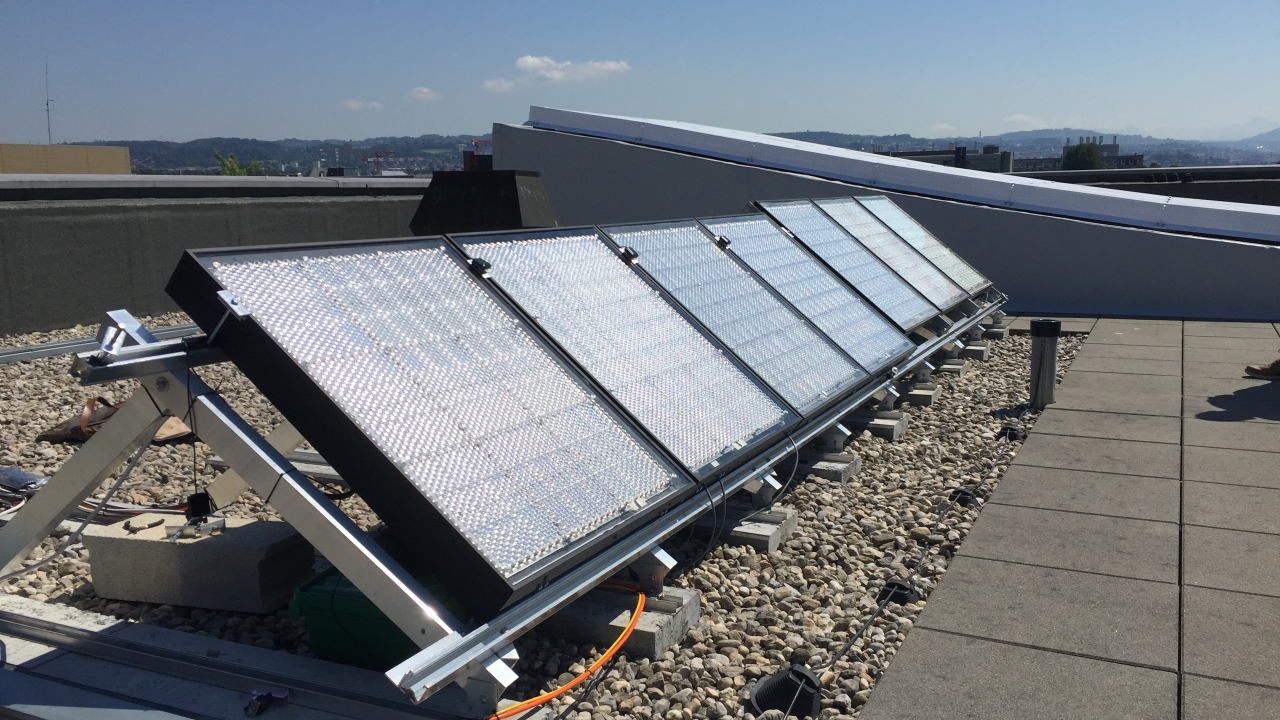
Efficient cells are set down on a grid. Above the grid, you will find a lens array that fundamentally bends light into a slender beam which is only concentrated on the small cells. As you know, the sun doesn’t stay in one place – so as it moves, so does the cell layer. This keeps the beams on the proper mark. Insolight has demonstrated up to 37 percent efficiency overall in terms of testing, as well as 30 percent efficiency in designs for individual consumers. In comparison to typical solar panels, this is twice the power. Below, you will find a little bit more detail about this process, as it is quite interesting and certainly worth explaining.

To elaborate, the cell array that has been developed will essentially shift each day only by a few millimeters in order to track the sun. Everything is enclosed in a thin module, comparable to traditional solar panels. This offers protection to mechanical parts. This innovative product has the same look as traditional solar panels and it can be mounted with ease on both the ground and rooftops.

Lab results suggest that a more efficient version of solar cells can be manufactured at a low enough cost for commercial usage, and efficacy can be tweaked over time.

Without a doubt, this solar endeavor brings some complication to present-day mass-manufactured arrays that might be adequate, but could be better. Worth noting is the fact that the new solar panels don’t differ in shape or size, as touched upon, nor do they necessitate the utilization of specialized hardware. The tests being run are demonstrating that these panels are very effective.

According to Insolight’s CTO, , the solar panels have been continually monitored and worked through winter weather, heat waves and even storms. This means the solar approach is effective even on days when the sun is hidden by clouds.

Insolight is currently working with solar panel manufacturers, in an effort to integrate this amazing technology with existing strategies.

Continue to follow solar news, as Insolight panels are anticipated to hit the market in the next two years. In 2022, you can expect some cool changes, to say the least!

Sources:

https://techcrunch.com/2019/02/19/these-hyper-efficient-solar-panels-could-actually-live-on-your-roof-soon/

https://insolight.ch/vision/

https://cleantechnica.com/2019/02/20/record-29-concentrating-solar-cell-aims-at-low-cost-manufacturing/

Photo Source: techcrunch.com/wp-content/uploads/2019/02/panels_summer_1280x720.jpg


Solgami Solar Energy Blinds Reinventing Urban Solar Energy Access

In the race to bring to every corner of the world, the biggest issue researchers and manufacturers of solar energy have faced is that of limited space. Especially in crowded environments, rooftop solar panel installations and other means of bringing solar energy to those areas are limited. Inventions, such as shared panels through solar community gardens have helped bring solar energy to some areas, but most major cities are still without practical renewable energy solutions. Architects and engineers everywhere are working to find a solution that will bring affordable and efficient solar energy to even the most populated cities. One Australian architect, in particular, has created an ingenious invention that will help larger cities receive solar energy. It is born from a surprising mix of window blinds and origami. 

How Solgami Works 

Solgami is an alternative to window blinds. The blinds themselves are constructed using a combination of thin solar cells and reflective, ink materials. The solar cells and the reflective materials are then placed onto transparent sheets and folded into triangular, origami-like shapes. Multiple triangular solar cells and mirror shapes are then placed together to form blinds that are approximately the size and width of plantation shutters. Any light coming through the window is then reflected through the blinds, moving through the mirrors and the solar cells. The mirrors in the Solgami solar structure help light to reach areas of the room typically not reached just from opening standard blinds. In addition to the light offered, solar energy is generated as sun passes through the blinds. There are three positions that users can choose from to place the solar blinds, ranging from completely closed, open, and somewhere in between. 

Solgami Competition 

Since 2015, the Solgami has undergone several revisions and design changes. It is also not the first city-focused solar energy project proposed in recent years. However, it is one of the most practical solutions offered thus far. One example of a similar solar energy project comparable to Solgami is Tesla’s SolarWindow. The biggest difference between the SolarWindow model and the Solgami is that the Solgami blinds do not require the same construction as the SolarWindow. The ease of installation offered by the Solgami can dramatically decrease costs and help large cities bring solar energy to businesses in crowded areas with greater ease. 

Solgami has received significant support from the solar energy industry, even recently landing a place as a finalist in the Lexus Design Awards 2019 competition. Lexus is now helping to fund a prototype for Solgami that is scheduled to be revealed at Milan Design Week this upcoming April. Out of over 1,500 entries, Solgami was selected to compete with 5 other finalists. By April 8, a sole winner will be announced and full production of the prototype will be explored.  

About the Solgami Creator 

Ben Berwick, lead architect and creator of Solgami, emphasizes that his Sogami solar blinds are a way to connect with the resources already here and the world around us. Utilizing the power of the sun is crucial to a renewable future and a philosophy that has guided Berwick’s design. His Solgami creation could potentially help millions of residents who live in urban areas worldwide. Figures are only expected to rise in coming decades when it comes to population growth in urban locations. Solutions like the Solgami make this future seem less daunting, knowing solar energy access and control may soon be easier than ever. 

Berwick has spearheaded several other solar energy projects through his architecture company known as Prevalent. Founded in 2017, Prevalent is based out of Sydney, Australia and works with both private and commercial solar energy customers. Burwick has over 4 years of commercial architecture experience in Sydney and 2 years of experience working with various architecture firms in Japan. Prevalent ultimately pushes for social change that will have an impact on the local environments in a positive way. 

Check out Solgami’s website to watch a video demonstrating how their solar blinds function and reflect light: https://www.solgami.com/ 

Resources 

https://www.inverse.com/article/39395-how-these-windows-could-rival-tesla-s-solar-roof-for-renewable-energy 

https://www.inverse.com/article/53172-these-origami-solar-panels-generate-electricity-for-apartments