Monday, June 10, 2019

NASA Could See Millions in Savings Thanks to Solar Project

A array project anticipated to make a big difference in terms of an environmental impact is being worked on at a flight facility. This facility is located in Wallops Island, VA. The expectation is that the renewable project will meet a minimum of 80 percent of the location’s electrical consumption, which would equate to more than $3 million in savings. The numbers are substantial. Read on for more information about this !  

The solar energy project is one which is savings-funded from . Prepare yourself to be even more impressed with numbers – it is anticipated to help lessen the carbon output for NASA’s Goddard Space Flight Center’s WWF, or the Wallops Flight Facility, by more than 4,300 metric tons on a yearly basis. If you are not familiar with this sort of measurement, you might be wondering what exactly this means. Well, according to Ameresco, that amount in terms of metric tons is comparable to canceling out CO2 emissions from electricity usage from more than 2,755 homes over the period of one year. Clearly, NASA is taking things to a new level when it comes to solar energy.  

There are improvements in terms of infrastructure and renewable energy to the tune of $14 million in regard to this solar project. How soon will savings be seen? In cost savings during the first year, it is expected that the number will be around $537,000. Down the line, energy conservation measures coupled with solar output will likely allow for more than $3 million in energy savings. Ameresco and NASA’s Wallops Flight Facility have a solid energy savings performance contract. As a result, the Wallops Flight Facility will not have any upfront costs. Rather, the project is going to be funded via energy cost savings that come from the solar installation.  

NASA’s Impressive Solar Project Details 

This impressive solar project is going to entail having ground-mounted solar panels set up in close proximity to NASA Wallops Flight Facility’s airfield – in addition, there will be carport-canopy solar panels. 

, director, communicated that the solar project is very important for a couple of reasons. For one, it sets the foundation for onsite generated energy to contribute to the current energy grid down the line. In addition, it creates an immediate clean energy source that will be put to good use – solar power.  

Pierce mentioned that having a installed so close to such an important airspace is rare. But the hope is that this solar project will act as a model to other facilities interested in using a solar farm to lessen their carbon footprint.  

A Solar Initiative Worth Emulating 

According to Ameresco’s executive VP of federal solutions, Nicole Bulgarino, the company has had an extensive history working with NASA. The companies work together on innovative projects and hopefully embarking on this brand new solar initiative will be something other flight facilities attempt to emulate.  

It seems to be an understatement to say that this solar farm is a great opportunity for NASA and Wallops. Solar Farm Project Manager, , commented on how this is a very visible project.  

This impressive renewable energy endeavor is going to make a big difference when it comes to NASA WFF meeting or even exceeding its goals for sustainability. Cutting non-renewable energy usage by 80 percent is certainly something worth talking about. It is no wonder that this huge solar farm is going to do big things, considering it is associated with NASA.  

Following solar news always reveals plenty of interesting projects and endeavors. We can all make a difference on a smaller level. It is remarkable when huge players such as NASA opt to make a difference for this world. It is an out-of-this-world solar project that will hopefully continue to lead the way for the future. It will be interesting to see if this is going to be something which might set the stage down the road for other companies to attempt to match or beat in the race to go green.  

Sources: 

https://www.energymanagertoday.com/182844-0182844/ 

https://www.solarpowerworldonline.com/2019/06/ameresco-developing-solar-project-at-a-virginia-nasa-facility/ 

https://solarindustrymag.com/solar-project-to-meet-80-of-nasa-facilitys-electrical-consumption 

https://www.delmarvanow.com/story/news/2019/06/06/wallops-breaks-ground-14-million-solar-energy-project/1364837001/ 

Thursday, June 6, 2019

Juliana V. United States: The Latest on the Fight against Climate Change

In , , federal judges listened to arguments earlier this week in an hour-long hearing regarding whether or not there is a legal right for young people to have protection against .  

There was push on both sides of the argument from the judges, who are from the Court of Appeals for the Ninth Circuit.  

The lawsuit is known as v. United States. A lead plaintiff is , and she could be seen greeting supporters outside of the courthouse on Tuesday.  

The case was originally supposed to begin last fall, however, the Trump administration was granted a pretrial appeal. The decision made could have huge implications regarding climate action being pursued in courts throughout the United States.  

The Fight to Protect Children Today and Tomorrow 

The plaintiffs are demanding the government do its part to protect not only today’s children, but future generations as well against the negative impacts of climate change. The plaintiffs filed a brief stating they are facing the risk of deprivation of their rights, due to federal government acts which knowingly harm the climate system.  

It is the desire of the federal government to see the case be dismissed prior to going to trial, but the argument is that the young people should have the opportunity to present their case against anyone who might harm them through governance. Moreover, the plaintiffs have requested that the government, while the case is pending, do its part to stop fossil fuel extraction projects.  

According to lawyers representing the Trump administration, the case is misguided and there actually is not a constitutional right to have a stable climate system. They don’t believe that a single district court in Oregon should be in charge of controlling environmental and policy in the United States.  

The judges on the panel held in Portland included  of the Ninth Circuit Court of Appeals, Mary H. Murguia of the Ninth Circuit Court of Appeals, and Josephine L. Staton of District Court for the Central District of California. They were each appointed under President Barack Obama.  

There was question over whether a lawsuit would be able to fix the issue at hand, assuming climate change is a problem caused by inaction of the government.    

A Climate Change Case: Is it Best Handled by the Courts? 

It should be noted that since this was originally filed back in 2015, the Obama administration made an effort to stop the case, due to the argument that the issues being presented would be better suited for the executive and legislative branches rather than the courts. The Obama administration did take steps to curb greenhouse gas emissions and signed the Paris climate agreement, whereas the Trump administration has announced a plan to exit the Paris deal and has sought to challenge science demonstrating that global warming is real, presenting an immediate need for action to take place.  

According to Philip H. Knight professor of law at the University of Oregon, , the Trump administration, while other nations are slamming on the breaks, is destructively “accelerating toward the climate cliff through its frenzied fossil fuel policy.”  

One of the plaintiffs, , discussed how some of the young people have spent a quarter of their lives involved in this case, which started with 21 young people suing the United States government through “Our Children’s Trust.”  

Vic Barrett, for instance, is now 21 years old, attending the University of Wisconsin. He has grown, as has the sense of urgency regarding the importance of addressing climate change. Barrett discussed how the youth climate movement is no longer just about the original 21 young people across America – it’s about highlighting young people all over America and their efforts to hold the government responsible for placing the future in danger.  

Attorneys for the 21 young people are optimistic this case will go to trial. Now, it’s up to the judges to decide whether or not the case will proceed forward or be thrown out. It is certainly worth following, for anyone concerned about climate change, to say the least!  

Sources:  

https://www.nytimes.com/2019/06/04/climate/climate-lawsuit-juliana.html 

https://www.latimes.com/science/la-sci-youth-climate-trial-juliana-court-20190604-story.html 

Photo Source: 

Eric Montgomery 


Award-Winning Solar Home Raising the Bar for Solar and Home Markets

Colleges across the United States and around the world are increasingly offering classes and degree programs that train individuals on  panel production, renewable energies, and innovative solar design. There is no doubt that competition among colleges, and even the students themselves, is increasing in this particular field. If there is any college that should be mentioned in connection with solar , it is . The Virginia Tech Center for Design Research has been heavily involved in solar design for nearly two decades. Despite rapidly changing solar technology, Virginia Tech has managed to stay on top of the shifts and develop solar homes that are not only stunning, but run solely on solar power. 

The History of  

After showcasing their solar home for the first time at the Department of Energy Solar Decathlon Competition back in 2002, the Virginia Tech Center for Design Research quickly began investigating how to make their solar home even more efficient. Then, eight years later in 2010, Virginia Tech’s solar home model won the Solar Decathlon Europe Competition in Spain. 

Following their win in Spain, Virginia Tech solar innovators were inspired yet again to continue to improve their . Around this time, the name FutureHAUS was born and another revolutionary evolution of this solar home began. Now, FutureHAUS would not just be outfitted and run on 100% , but would also be constructed to include smart home technology systems. 

 In November of 2018, FutureHAUS competed against 14 other international universities and won first place in the Solar Decathlon in the Middle East. In addition to their overall first place win, the team also claimed first place in architecture, first place for creative solutions, second place for interior design, second place for energy efficiency, third place in engineering and construction, and an additional third place prize for sustainability. According to members of the FutureHAUS team, focusing on interdisciplinary knowledge, as well as the unique experiences and expertise of their members, is what helped FutureHAUS to take off. 

Taking FutureHAUS to Times Square 

Most recently, FutureHAUS was featured at NYCxDesign, the New York City annual celebration of design. The solar home was constructed right in the middle of Times Square in a “Lego-like” fashion, allowing witnesses a glimpse into just how the FutureHAUS solar home is built. The FutureHAUS constructed in New York City is not considered a tiny home, but at 900-square-feet, it is considered a compact home. The room layout, combined with innovative space-saving features and other modern upgrades, make this solar home seem much more spacious than its 900-square-foot label. While on display in New York City, those passing by had the chance walk-through the solar home and experience a small taste as to what it might be like to live in one for themselves.  

What Can We Expect Next from FutureHAUS? 

Students and faculty at Virginia Tech that are involved in the collaborative efforts that comprise FutureHAUS hope that the solar home may one day change the home building industry entirely. With traditional homes, materials are shipped to the location and the residence is constructed on-site. With FutureHAUS, any mass-produced homes would be constructed off-site and shipped to the home’s new location instead. Researchers at Virginia Tech are looking to streamline this process by emulating procedures followed by Henry Ford’s infamous vehicle production line.  

Continuing to combine solar energy with security will be a top priority for the FutureHAUS team. The Virginia Tech Department of Computer Science’s Center for Human-Computer Interaction stepped in to collaborate with FutureHAUS solar researchers and builders to further develop the technological components of the solar home. With the help of Virginia Tech’s Computer Science Department, automatic doors, touch screens, and even automatic water dispensers have been installed throughout the home. With how innovative FutureHAUS is, in addition to the hard work and collaborative efforts that have made its existence possible, the team hopes to further revolutionize the home solar industry and make clean living a possibility for everyone. If one thing is certain, we can expect to see more promising advancements from the FutureHAUS team very soon. 

Photo Credit: © Erik Thorsen, 2018  

Resources: 

https://www.curbed.com/2019/5/31/18634415/prefab-home-futurehaus-solar-decathlon-virginia-tech 

https://www.futurehaus.tech/history/ 

https://vtnews.vt.edu/articles/2018/11/eng-caus-futurehausresults.html 


Monday, June 3, 2019

Facebook to Finance Huge Solar Farm in Texas

is making a big investment in a huge in as part of its admirable goal to run 100 percent on renewable by the end of 2020.  


The project is being built in Andrews County, TX by Longroad Energy, a renewable energy company. It is being referred to as the Prospero Project.  

The farm is anticipated to be up and running in 2020, with a capacity of just under 380 megawatts. This is going to be one of the largest solar farms in the nation at 4,600 acres and the solar capacity would equate to enough power for 300,000 houses. As another point of reference, this land located in West Texas is roughly five and a half times the size of Central Park. The numbers are certainly impressive and worth talking about!  

With the scale and size of the solar farm, it is expected to deliver $21 million in terms of local property taxes.  

A Solar First for Facebook 

This is the first time that Facebook has made a direct investment in a renewable energy project, and it is a huge solar project at that. The company contributed a significant amount toward the total costs, which fell in the ballpark of $416 million. In terms of this solar project, Facebook is the only tax equity investor. Some of the output from the solar farm will be sold to Shell, and the energy will then be re-sold. Of course, both Shell and Facebook will have the ability to obtain renewable energy tax credits.  

In accordance with a statement by , energy strategy manager for Facebook, there is a lot of excitement surrounding the company being one of the first to utilize a direct investment in order to meet renewable energy objectives. The hope is that such investments will be a means of engaging with projects, which could essentially be easier for companies in comparison to a longstanding power purchase agreement. This would unlock different options for more companies to meet their objectives and grow the market.  

Freed further discussed that when Facebook selects new renewable energy projects to get involved in, it searches for ventures that otherwise might not have happened. With regard to the Prospero Solar Project, Freed mentioned being involved early on in order to ensure the company’s involvement helped the solar project to move forward.  

Facebook’s business runs largely on renewable energy (to the tune of 75 percent of its business), to include solar, as of last year. The company could serve as a model for other companies that plan to run on renewable energy sources such as solar. Other tech companies already run on solar and other renewable energy sources. Google and Apple are both utilizing credits and carbon offsets in an effort to eliminate fossil fuel usage. Both companies have plans to run totally on renewable energy at some point in time. It is worth noting that the suppliers used by world-renowned Apple utilize clean energy, such as solar, as well.  

Solar and Wind Power Deals 

Facebook has signed deals to purchase both solar and wind power in close proximity to its data centers located around the world, so clearly the company is taking its clean energy efforts very seriously.  

Hopefully, other large companies will take note and do their part to get involved and limit their carbon footprint. Investing in solar projects is a great thing for our planet. Keep reading up on solar news to stay in the loop regarding the most recent solar projects and developments in clean energy. Think about small steps you can take to make a difference, too. While most people don’t have millions of dollars available to invest, we can all do little things that will add up to make a big difference for our planet. Facebook is certainly making impressive moves in financing this huge solar farm in Texas. It will be interesting to see if other companies follow suit!  

Sources:   

https://www.engadget.com/2019/05/31/facebook-solar-farm-texas-renewable-energy/?guccounter=1 

https://www.fastcompany.com/90356697/facebook-is-investing-hundreds-of-millions-in-a-gigantic-new-solar-farm 

https://www.greenbiz.com/article/facebook-now-proud-owner-massive-solar-farm 

Thursday, May 30, 2019

How India is Making the Switch from Coal to Solar Utility 

Making the switch from -generated utility to and energies is a shift that countries all over the world have been pursuing. , in particular, is showing a lot of promise in this regard. As the second-most populated country in the world, as well as the third-largest region to emit the most greenhouse gases, India is in a unique and critical position when it comes to committing to . Law and policy makers in India have been well aware of the global climate crisis. Through an increase in clean and solar policies, as well as a decrease in the costs of solar panels in the region, India is implementing changes in the solar energy field that are causing the rest of the world to take notice. 

Reduced Coal Generation and Spending in India 

For the third year in a row, solar and renewable energy investments in India have outnumbered the amount of coal-based fuel investments. Additionally, spending on solar energy in the region surpassed coal generation for the first time in 2018. Although coal-generated utility continues to grow in the region, it is not growing nearly as quickly as it once was. The International Energy Agency (IEA) predicts that coal-utility may decline from around 74 percent of the world’s total electricity that it is today, to about 57 percent by 2040. When more aggressive measures are taken into consideration, the IEA predicts that this reliance on coal utility could be as low as 7 percent by 2040. With more solar panels and solar farms popping up across the country every year, this ambitious prediction may one day become a reality. 

Sameer Kwatra, climate change and energy policy analyst for the Natural Resources Defense Council mentioned that India’s coal generation dropped from around 20 gigawatts of additional capacity per year to around less than 10 percent in just three years. In light of this statistic, Kwatra mentioned that it is now clear that solar and renewable energy utilities just make more sense.  

Solar and Renewable Energy Commitments 

In addition to the solar policies and renewable energy incentives put in place by lawmakers in India, various projects across the region prove that the country and its people are serious about helping the planet. One of the greatest challenges that India will face is upholding this commitment while juggling being one of the number one coal importers in the world. Part of the demand for so much electricity in India is due to the hot weather that makes pumping one’s air conditioning a much higher and immediate priority than attempting to install solar panels.  

However, India is up for the challenge. In 2015, India pledged to install 175 gigawatts of renewable and solar energy capacity in the country by 2022. This particular goal is part of the region’s commitment to the Paris Agreement. The Paris Agreement is an agreement that unifies various countries around the world willing to invest in long-term solar energy and renewable energy goals that will help positively impact global temperature levels. The agreement also defines certain provisions financially and logistically that help countries make the right decisions about solar utility in ways that are cost-effective and efficient. 

The Future of Solar in India 

Although the switch to solar energy may seem daunting, if a country as large and populous as India can make positive changes in solar panel affordability and construction, so can other countries. The time for negotiating whether or not implanting solar energy is a good idea has long since been over. Countries and regions that are willing to look to solar energy as the solution and take affirmative action to implement solar utilities will come out on top.  

Many of the positive changes that have occurred in the solar energy realm in India have been due, in part, by initiatives taken by the current prime minister Narendra Modi. The solar energy policies he has set in place have ultimately changed India’s focus and boosted interest in clean and solar energy generation. It is possible that any continued or future progress that will be made in the region in terms of solar and renewable energies may depend on the results of the next general election. 

Resources: 

https://insideclimatenews.org/news/20052019/india-solar-investment-coal-modi-election-renewable-energy-future 

Wednesday, May 29, 2019

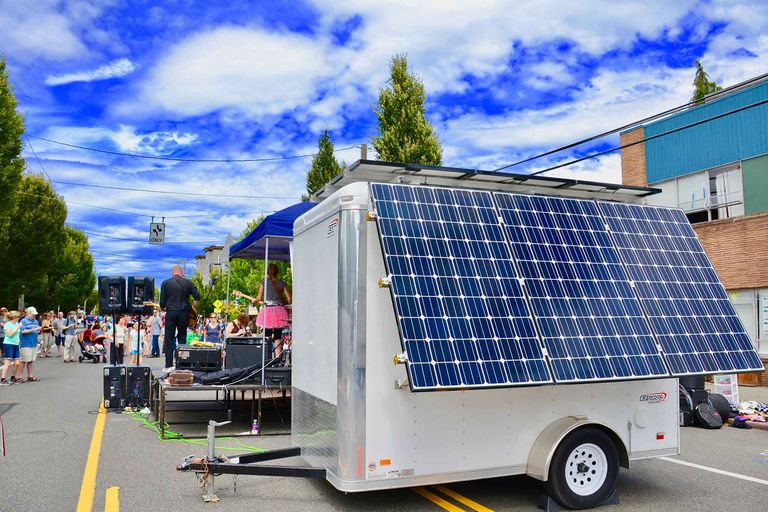
A Small Solar Rover Provides Off-Grid Power in Seattle

Former real estate agent  has created a portable source of – a Northwest . Brandon is a – installer and designer worth talking about, as she has the ability to help power events in the using a solar-powered, off-grid generator built by hand.  

Solar Rover – Bringing Power to Parties & Events in the PNW 

Brandon’s Northwest Solar Rover is able to provide power to all sorts of activities and events, including parties, concerts, athletic events, festivals and weddings. She is able to power cell phones, Leaf cars and so on. With the ability to tow the solar rover to any location, all she has to do is plug in to take advantage of easy, clean energy.  

Brandon has an impressive background. She relocated to the from the Southeast, where she was selling old homes. She wanted to have a career that would help the planet rather than impact it in a negative way. This is an admirable mindset and one more of us need to have! After noticing solar power on homes in her area, she began doing research when she came across Solar Energy International, a school that educated her on the design and installation of solar energy. Her first relevant job popped up back in 2008.  

Since then, Brandon has provided power at the Climate Solution rally – specifically to Gov. Jay Inslee’s stage. This was a memorable event because Inslee signed numerous climate-change bills, in a victory for Washington State. Supplying the solar energy was something that felt good for Brandon.  

Being able to provide clean power via solar energy in various outdoor settings is something Brandon appreciates about her job. The ability to educate about solar energy is a bonus.  

When asked what surprises people about what she does, Brandon discussed how there tends to be a sense of amazement over the concept of having a solar-powered rover in Seattle, where the sun is somewhat lacking. If you know anything about Seattle, you know it is known for getting a lot of rain. But the solar rover is able to work even in rain and cloudy weather. According to Brandon, Seattle is a great place for solar power due to the long summer days.  

Mini Solar Panels – What You Should Know 

The discussion of a solar rover might raise questions about smaller-scale solar panels. Mini solar panels are a great source of power when it comes to portable appliances and small devices. A solar panel is made up of photovoltaic cells, and these cells are made using semiconductor materials or silicon. Mini solar panels, unlike normal ones on rooftops that measure roughly 65 by 39 in, might range in size from just over half an inch by 2.5 in to just under 9 in by 5 in. Of course, there are various sizes which can be made, and this is something that is very convenient, especially when discussing portability.  

How the Panels Work 

A small solar panel’s photovoltaic cells will receive energy that they then absorb when exposed to sunlight. The energy which is absorbed is transferred to the semiconductor, and this helps to deliver current and voltage. These small solar panels are convenient when limited space is an issue. Mini solar panels can be used to power items like flashlights, calculators, radios and so on. As mentioned previously, Brandon has demonstrated the ability to power cell phones.  

Taking advantage of clean energy is something which is tremendously important to the health of our planet. Not only can we lessen our carbon footprint, but we can save money in electric costs. It is worthwhile to follow solar news to stay on top of new developments in the world of clean energy. Have you ever seen a mini solar panel, or some sort of portable clean energy system? What changes can you make in your day to day life to improve the health of our environment? It could be something as small as not using plastic bottles or straws when possible. Or you could end up having solar panels installed on your rooftop. There are so many options, and they are worth thinking outside the box for – just ask Jennifer Brandon – she certainly has demonstrated creative thinking and innovation in her work.  

Sources:  

https://www.seattletimes.com/explore/careers/her-small-but-mighty-solar-rover-powers-events-around-seattle/ 

https://economictimes.indiatimes.com/small-biz/productline/power-generation/mini-solar-panel-ideal-power-source-for-small-devices/portable-appliances/articleshow/69412749.cms 

Photo Source:  

https://static.seattletimes.com/wp-content/uploads/2019/05/web-solar-rover5.25_DSC_0024-768×512.jpg 

Wednesday, May 22, 2019

Offshore Solar Making Waves Worldwide

The functionality and use of inventions have made their way into conversations in recent years in a big way. Offshore solar is seen by many as a solution to the ever-present problem of the limited space we have to construct . Rooftop solar panels and community solar gardens are not ideal for all settings in the United States. Despite progress in this area and leaders in the field that are working to integrate solar panels more seamlessly with everyday construction, more still needs to be done in order for us to continue down the path towards a renewable future. 

This is why nearly every country in the world is currently cultivating offshore solar farms, or is, at the very least, discussing the benefits that may come from the construction of such offshore solar innovations. Offshore solar consists of on top of large bodies of water or offshore wind turbines. These two primary renewable energy mechanisms are able to perform just as solar panels and wind turbines on land do – except they utilize bodies of water to take up space, rather than the limited land space that our earth has. 

Many are hopeful that offshore solar will be the solution to many of the drawbacks and downsides inherent in solar panels. It is possible that more people may even be more likely to invest in solar power plants and farms, if it means that the construction of such renewable energy sites does not interfere with the look and feel of their cities, with solar panels being plastered on every rooftop, for example. With offshore solar, individual rooftop panels and other space-taking renewable energy farms will not be as necessary. Although offshore solar projects cost more to construct, they are twice as efficient thanks to the cooling effects of the water, which extends the life of the panels and helps reduce thermal losses. 

International Offshore Solar Leaders 

There are two countries that have consistently been at the forefront of the offshore solar race. Both Singapore and Japan are making strides in the offshore solar industry, proving that offshore solar is not just effective, but a potential space-saving solution that will allow solar panels to be built in mass. 

Singapore Offshore Solar 

Because the country is particularly land-scarce, Singapore has had an advantage and opportunity to break-in to the offshore solar industry from the start. In addition to the abundance of sunlight year-round and plenty of water surrounding the country, it is no surprise that the offshore solar industry in Singapore is taking off. 

The biggest project currently underway in Singapore is a floating solar farm being led by a renewable energy provider known as Sunseap Group. The will generate 6,388MW-hours of renewable energy per year and ultimately reduce greenhouse gas emissions by 2,600 tons every year. The Sunseap Group is actively looking for other locations in the region to build more floating solar farms, such as in reservoirs and other areas along the coast. 

Japan Offshore Solar 

If Singapore has a problem when it comes to available land to build solar panels, Japan has even more of a crisis to manage in this right. However, just like Singapore, Japan also has plenty of surrounding water available to construct offshore solar panels and floating solar farms — and Japan has long since taken advantage of its surroundings. The country was the first to successfully construct a floating solar panel and its reservoirs now hold 73 of the world’s 100 largest floating solar farms. 

The Future of Offshore Solar 

From 2014 to 2018, the worldwide output of floating solar panels increased 100-fold. While there has been notable enthusiasm surrounding floating solar panels and other offshore solar systems, some have questioned whether or not the idea will really be as beneficial as it is anticipated to be. Critics of offshore solar have mentioned concerns about weather in particular regions, especially in Japan, and how typhoons and other extremes will impact floating solar panels. There has also been concern over ecosystem changes or interruption due to the solar panels blocking out sunlight. These potential impacts, however, can only be speculated for the time being. We can at least take comfort in knowing that the problems involving having enough space for solar panels to be placed may finally be solved. 


Resources: 

https://oilprice.com/Alternative-Energy/Solar-Energy/Who-Is-Winning-The-Offshore-Solar-Race.html 

https://www.straitstimes.com/singapore/sun-seeker-at-sea 

https://www.weforum.org/agenda/2019/03/japan-is-the-world-leader-in-floating-solar-power/